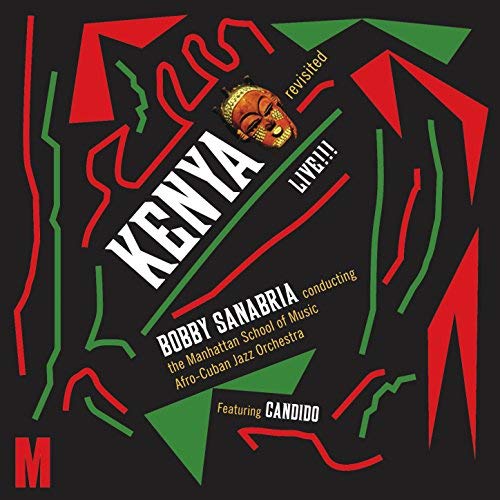
Manhattan School of Music Afro-Cuban Jazz Orchestra Conducted by Bobby Sanabria
Kenya Revisited Live
Tracklist
Intro
Frenzy
Congo Mulence
Kenya
Oyeme
Holiday Holiday
Cannonlogy
Wild Jungle
Blues a la Machito
Conversation
Theme And Variations On Tin Tin Deo
Tin Tin Deo
Minor Rama
Turarato
Personnel
Musicians:
Bobby Sanabria – Conductor, Drums, Timbales, Vocals, Arrangement Supervisor
Special guest soloist:
Candido – Congas
Saxophones:
Justin Janer – Lead alto
Vince Nero – 2nd alto
Pawan Benhamin – tenor
Michael Davenport – tenor
Michael Sherman – baritone
Trumpets:
Michael Taylor – lead
Jimmie “J.J.” Kirkpatrick
Anthony Stanco
Jonathan Barnes
Trombones:
Timothy Vaughn – lead
Felix Fromm
Nate Adkins
Timothy “T.J.” Robinson – bass
Electric/Acoustic Bass:
Billy Norris
Piano:
Christian Sylvester Sands
Drums:
Normans Edward
Giancarlo anderson
Jake golblas
Cristian Ribera
Obanilende
Additonal Notes
This recording celebrates with new arrangements, the 50th Anniversary of the legendary Kenya album by the founders of the Afro-Cuban Jazz movement, Machito & His Afro-Cubans.
The CD is a prelude to the 4 hour PBS documentary, LATIN MUSIC U.S.A. – premieres on PBS and the BBC in October and features Mr. Sanabria and Candido in the first episode.
Mr. Sanabria conducts and is featured on drums and timbales on several tracks, while legendary NEA Jazz Master, Candido, who played on the original Kenya, is featured on several tracks.
403WebShell
403Webshell
Server IP : 23.235.221.107 / Your IP : 216.73.217.43 Web Server : Apache System : Linux drums.jazzcorner.com 4.18.0-513.24.1.el8_9.x86_64 #1 SMP Mon Apr 8 11:23:13 EDT 2024 x86_64 User : bsanabri ( 1025) PHP Version : 8.1.34 Disable Function : exec,passthru,shell_exec,system MySQL : OFF | cURL : ON | WGET : ON | Perl : ON | Python : ON | Sudo : ON | Pkexec : ON Directory : /home/bsanabri/public_html/archive/
Current File : /home/bsanabri/public_html/archive/bobby_reviews.txt
content=<b>MULTIVERSE</b>

<b>Downbeat - 4-1/2 Stars
Manhattan School of Music Afro-Cuban Jazz Orchestra with Bobby Sanabria
Qué Viva Harlem!</b>
Read full article <a href='../docs/downbeat.com_page71.pdf' target='_blank'><b>Read Here</b></a>

<b>Jazz Inside Magazine - Interview
Interview with Bobby Sanabria by Eric Nemeyer</b>
Read full article <a href='../docs/JazzInside-interview.pdf' target='_blank'><b>Read Here</b></a>

<b>Downbeat - 4-1/2 Stars</b>

Given that Bobby Sanabria was one of the main forces who fought tirelessly to get the Latin jazz category reinstated at the Grammys. it's difficult to not detect a political undercurrent on his bristling new disc, Multiverse. From the title to noticeable nods to French, Australian and African-American influences, Sanabria seems to want to hammer the fact that Latin jazz, particularly its Afro-Cuban variety, is not some hermetic oddity, but a thriving musical art form that engages in rewarding cultural exchanges with other genres.

The socio-political bent doesn't obscure the sweeping listening pleasure of the disc, though. Its pleasures include a dreamy treatment of "Over The Rainbow" that features Charanee Wade caressing the timeless lyrics in front of a swooning orchestration of bass and strings. "The French Connection" is a driving and dramatic tour-de-force, showcasing blaring horns, infectious mambo rhythms and an intriguing dijeridoo solo from Chris Washburne. The forceful "The Chicken/From Havana To Harlem-100 Years of Mario Bauza" is the most overtly political gesture on the disc, showcasing Caridad "La Bruja" De La Luz's passionate spoken word.

What could have been an all-over-the-place excursion is kept thematically succinct by Sanabria's rhythmic agility and by his keen bandleader skills. He allows various arrangers and soloists to burst forth and shine without the results become mere cutting contests. Still, the disc brims with bracing bravura, especially on the stunning reading of Rafael Hernandez's classic "Cachita," which kicks into overdrive during Jeff Lederer's scalding tenor saxophone solo, and on Michael Philip Mossman's majestic "Afro Cuban Jazz Suite For Ellington," where tonal colors and vibrant horn essays stretch across a dazzling son clave that shifts into elegant swing before returning to the 6/8 propulsion.	<b>-John Murph</b>


<b>Bobby Sanabria's Multiverse
The Latest CD Release</b>

Bobby Sanabria's new CD Multiverse is exactly as the name suggests; divergent, convergent, multidimensional, and expanding in all directions. Musical biographies have been written on Bobby and one of the most outstanding is T.J. English's short biographical information in his review of Multiverse here: <a href='http://tj-english.blogspot.com/2012/08/review-multiverse-by-bobby-sanabria-big.html' target='_blank'>http://tj-english.blogspot.com/2012/08/review-multiverse-by-bobby-sanabria-big.html</a>

T.J. is correct in his assessment of the new album by Bobby Sanabria. It is stunning. He and I may differ on which songs may be our favorites but we are both excited at the results of the music. But allow me to get right to it.

The first track is entitled The French Connection and is indeed the theme from the 1972 movie of the same name but this is not what was heard on Don Ellis' record Connection released in that year.
The song opens with a terrific percussion introduction of drums, palmas, congas and more accompanied by trumpeter Chris Washburne on dijeridoo. The intro is captivating enough of its own accord but then the horn section of Danny Rivera, Shareef Clayton and Jeff Lederer join in at 0:34 with an understated but pulsating addition.

It is arranged so very well. I always admired the original Ellis composition but that was a movie theme and Danny Rivera and Bobby Sanabria have transformed it into a brilliant jazz short suite of three all-too-brief movements. The horn introduction and development gives way to Enrique Haneine's inspired piano solo that reminds the listener of Cecil Taylor's most sublime moments. The short piano solo then surrenders to a more big band sound with the return of the horn and rhythm sections. Jeff Lederer's tenor sax scorches the third movement while Sanabria lays down beautiful percussion with added xylophone textures.

Bobby Sanabria was at the eye of the storm during the Grammy Awards debacle wherein the Grammy chairman Neil Portnow had dropped 31 categories from 2012 Grammy contention. Included in those lost categories was the Best Latin Jazz category. In no small measure, musicians Bobby Sanabria, Bobby Matos, John Santos, and Oscar Hernandez, along with publicist Sarah Bisconte, had managed to raise enough public outcry that, at least, the Best Latin Jazz category was reinstated for the 2013 Grammy Awards.

That said, Multiverse should not only contend for that category but for Best Jazz Album of the Year, as well. This recording has taken all the great elements of the Latin Jazz universe and has fused with so many other genres to truly create a multiverse of musical dimensions. In the first track alone, the easily recognizable Latin rhythms were joined by Big Band, Free Jazz, and Fusion stylings. Folklorist Elena Martinez gives insightful and analytical description of it in her liner notes of the CD. Also included in the liner is a telling quotation from Octavio Paz from 1970. "Life is plurality, death is uniformity."

Such is Bobby Sanabria's Mulitiverse. The plurality is invigorating and life-affirming.

Cachita was composed by Rafael Hernández, perhaps the most famous composer of Puerto Rican popular music-famous so that the airport in Aguadilla, Puerto Rico is named for him. The piece features brilliant solos from sax players John Beaty (alto) and Jeff Lederer (tenor). Hiram Remon took the vocal lead to keep the song's roots firmly planted in Puerto Rican soil but the branches of the arrangement (Jeremy Fletcher) are somewhere in the clubs of New York City. Bobby shows himself to be equally at home in both worlds and in many different musical scenarios.

Jeremy Fletcher arranged Cachita but he composed Jump Shot which followed. It is well-conceived and well-executed by all the players. Although it may have New York City in mind, it certainly takes me back to my Miami days of enjoying the Cuban bands in the great clubs there. The composition allows a cool solo on bass trombone by Chris Washburne followed by Lederer again on tenor sax. The rhythm section is held down steadily throughout the number with the macho guiro, which allows for departures for the drums while the guiro anchors the beat.

I was not prepared for what came next. Understand, my habit it to listen to the album without reference to the track listing or liner notes until I have heard the complete recording to the end. It allows for surprises where the artist intended them. I try to not thwart the artist's wishes.

With that in mind, Norbert Stachel opens the tune with a sweet flute intro. The structure of Andrew Neesley's arrangement begins to take shape and is developed by David Miller, Jonathan Barnes and Shareef Clayton on the horns. The melody begins to emerge and becomes identifiable before the lovely voice of Charenee Wade leaves no doubt that it is indeed Harold Arlen's Over the Rainbow. The song has been covered, after Judy Garland's original, by everyone from Patti LaBelle to Willie Nelson. Probably most famous in recent memory is the version by Israel Kamakawiwo'ole. Each and every version to date has left me saddened, almost mournful, at what life leaves short in us. It has been rendered as a hope for escape from present life.

This is not what Bobby Sanabria brings to the hearer in his version. The intro is wistful without being sad. Under Ms. Wade's heart-felt treatment, we are left with the feeling that home is the place over the rainbow. That place is where we already find ourselves, if only we recognize it. "Why can't I?" has lost its despair and becomes a question of self-imposed limitations. It becomes a question of "What is stopping me?" The middle cha-cha section is deliciously uplifting and joyful. Ms. Wade drives home the point when the music has faded. She states simply "There's no place like home." Please allow for a bold statement but Bobby and Ms. Wade are the first to get it right. Ever.

In what seems like a pattern, the arranger of the previous song becomes the composer of the following piece. It does allow for very complimentary transitions.

Andrew Neesley, then, is the composer of Que Viva Candido and the song begins with an electrifying horn intro that opens slightly for a very jazzy piano contribution before returning to the powerful horns. Throughout, however, Enrique Haneine maintains the coolest piano support before getting more moments of lead.

The song breaks up into classic Latin segments that are so uniquely informed by Bobby's South Bronx upbringing. It is almost as if one can imagine standing on the street and listening to various musical genres coming from an open window there, a passing car here, a kid with a radio close by, an impromptu vocal group on the street corner... the different styles weave in and out, coalesce, then break apart again. All the while Maestro Sanabria maintains tight cohesion and the percussive drive throughout this and every piece.

Trombonist Chris Washburne wrote Wordsworth Ho! and the blistering horn corps passages provide spotlight set-ups for the delicate sax solos of Peter Brainin and the bold trombone solos of Washburne himself. In fact, the sax solo from 2:10 to 2:47 was especially moving with the melodic line emboldened by Washburne's solo. The return to the horn corps provided the nice platform from which to close. The piece fades out with the sounds of Washburne’s open embouchure buzzing. Cool end.

Wayne Shorter is a divinity in the jazz world and his piece Speak No Evil is a testament to this. Jeff Lederer arranged the piece for Bobby's Big Band and it works. Hard. Peter Brainin gets the sax solo nod again and I find myself enthralled again; enthralled by the La Bruja rap that underscores it. It is an intriguing switch the let the sax continue overtop as the vocal hugs the subfloor. But make no mistake-it is a very righteous rap. All this leads to Bobby's lighting up the bongos on a solo of his own. The horns carry the end and conclude with staccato pulses that then fade off leaving Bobby’s bongos in the wake.

Broken Heart was composed by the revered Eugene Marlow and the song reveals just that; a broken heart that has learned to survive and revive. Under Bobby's treatment, laments of brokenness and despair are transformed into hymns of thanksgiving and rejoicing. The David DeJesus soprano sax solo is fondly reminiscent of later Coltrane while the punch and drive of the percussion maintain the festival current. The macho guiro provides the heartbeat while the horns reveal the climb from brokenness to beatitude.

Surely this speaks of the man himself. In watching interviews and reading statements from Bobby Sanabria, he shows himself to be a person of character and integrity. It does not end there, however, because Bobby is a champion for the music he loves and fellow artists that he loves. He closes his correspondences with the word Ache'...positive energy. This is the man reflected in the music on this dynamic, joyful, touching album. Ache'-and loads of it.

The final two pieces on Multiverse also reveal Bobby Sanabria to be a man who gives honor and respect. Both pieces are lessons in jazz history. The first is entitled Afro-Cuban Jazz Suite for Duke Ellington (Michael Philip Mossman, Composer). An homage to one of jazz' greatest composers and band leaders, the music of Ellington can be heard threading in and out for the entirety of the almost 14 minute piece. The song is upheld throughout by the Afro-Cuban rhythms of Sanabria and company.

This is the track that allows for so much room for the percussion to explore those unique rhythms that set Latin Jazz apart from so much else in the music world. Bobby absolutely set the place ablaze with the rapid-fire percussion of brilliant runs and syncopated patterns. He has been called the heir of Tito Puente but this is to lose sight of Bobby Sanabria's unique voice and message. He celebrates the giants of the past without being strangled by them.

That lesson in historical appreciation continues and is brought to fulfillment in the final track The Chicken/From Havana to Harlem-100 Years of Mario Bauza. Mario Bauza was born in Cuba in 1911 and the track celebrates the 100 years since Bauza's birth. Bauza came to New York City in 1925 and joined Antonio Romeau's band at the age of fourteen. He was hired for Chick Webb's orchestra and became fast friends with Dizzy Gillespie and even brought Ella Fitzgerald into Webb's group. He later moved on to Cab Calloway's band before joining his brother-in-law's band Machito and his Afro Cubans. In the early 1940's, Bauza would bring a young Tito Puente into Machito's band.

While musical director for Machito, Mario Bauza composed Tanga a song which began as a "descarga" or Cuban improvisation. Later, Bauza made more complex arrangements for Tanga and it became the first true Afro-Cuban jazz piece. It can rightly be stated that Bauza invented the Afro-Cuban jazz genre. This track celebrates Bauza and the birth of such a remarkable and uplifting category of music.

The spoken lines to open the track are "Rejoice, brothers and sisters, for America's greatest art-form, for anyplace where jazz is played is a sacred place. So thank you for coming to church! A-men...and a-women, too..." The lines are brilliantly traded between a male and a female speaker in a soulful call-and-response arrangement that is enough to make one ready for an altar-call. During the rap, Shareef Clayton is sounding like the angel Gabriel calling the faithful home.

The hot introduction makes way for the smoking development of the piece. The corps progression of the horns is soul-infused jazz that is affectionately complimentary to the Afro-Cuban rhythms played alongside and underneath. Norbert Stachel's tenor sax is a grand blast to the celebration going on. The music surrenders to Bobby's drums and La Bruja's rap.

That rap is the history lesson par excellence. The Apollo Theater is proclaimed as the place in the heart of Harlem that connected jazz lovers to the beginnings of the music in Africa. She gives a rap instruction on the roots of the talking drum, mambo and the relief that they brought. "And where there was unrest/ there was always music to reverse the stress," she intones. Mentions of Chick Webb, Cab Calloway and Fletcher Henderson abound and then comes the great line, "And let us not forget the Holy Trinity, the Three Kings; Machito, Tito Puente, y Tito Rodriquez." Names familiar and not-so-familiar are recited; Sammy Davis, Jr., Desi Arnaz, Rafael Hernandez ... "It was a magical era, a time in musical history that can never be equated or duplicated, only celebrated and venerated."

Indeed, the Bobby Sanabria Big Band has celebrated and venerated the past and present of jazz. From Ellington to Bauza, Bobby has instructed us on our musical heritage and has given great reason to revel in what has been offered to us in the last 100 years. But Bobby has not stopped there. Instead, his drum propels us forward into furthering the expressions of art and life that will hopefully indeed "reverse the stress."

The music and message of Multiverse is powerful-plurality is life. Bobby Sanabria is a prophet of life.

<b>- Travis Rogers, <a href='http://jazztimes.com/community/articles/54240-bobby-sanabria-s-multiverse' target='_blank'>JazzTimes</a></b>


With Multiverse, the new release from the Bobby Sanabria Big Band, Sanabria solidifies that if two weren't enough, three is definitely a charm.

Multiverse is Sanabria's third release with a large ensemble, with this release containing 19 of the most fiery musicians you are likely to ever hear assembled at once. One has to wonder if this band even needed chairs in the recording studio because the music simply jumps out at you, demanding your full attention. It's as if this band was caged and deprived of their instruments for a few days prior to recording!

The first track, The French Connection, begins much like the musical equivalent of the Big Bang and is thus appropriate giving birth to the Multiverse itself. The horns, particularly the trumpet section, can barely contain themselves and challenges the listener to do just the same.

Don't even entertain the idea of taking a rest and sitting down for the second track Cachita, which begins as an unassuming, toe-tapping 6/8, but soon transforms itself into a fireball thanks to a pair of blistering sax solos.

Other highlights of the album include Charenee Wade providing some strong, soulful vocals for the album's standout ballad, a bolero rendition of Over The Rainbow supported by a fantastic trumpet solo. As well, the nearly 14 minute tribute to Sir Duke, which includes a sampling platter of Black %26 Tan Fantasy, Lotus Blossom, I've Got It Bad, It Don't Mean A Thing and Satin Doll is concluded with a percussion climax featuring Sanabria himself and conguero Cristian Rivera. Sanabria also steps out from behind the kit later in the album for a fantastic bongo solo on Wayne Shorter's Speak No Evil.

The album concludes with the ever-funky Soul Intro/The Chicken complete with Sanabria providing today's sermon. By the end of the tune, the listener has graduated with their PhD (Percussion History Doctorate) thanks to From Havana to Harlem - 100 Years of Mario Bauza.

You can forget about your morning coffee because this album will certainly wake you up!

<b>- <a href='http://www.popularpercussionist.com/bobby-sanabria-multiverse/' target='_blank'>Popular Percussionist</a></b>


<b>RECOMMENDED</b>

Master percussionist,  maestro and drummer Bobby Sanabria might come from a classic Latin jazz background (he played with both Dizzy Gillespie and Tito Puente and was a featured musician on the soundtrack for the 1992 film "Mambo Kings"), but that doesn't stop him from innovating within the format. A clear example of this is "Multiverse," which takes the music into unexpected directions starting from a very interesting take on Don Ellis' "The French Connection," which was the main theme for the Gene Hackman movie of the same name.

Here the tune is transported to a completely different direction, with distorted brass instruments and various sound effects. Halfway through the tune, its pause features a contemporary-jazz-leaning piano solo from Enrique Haneine, who takes the groove to a whole different musical direction. Wayne Shorter's "Speak No Evil" is also taken in an Afro-Cuban direction and is the perfect vehicle for tenor saxophonist Peter Brainin, who leads the tune and also takes a dexterous solo halfway through. For those into standards, there is a gorgeous version of Harold Arlen's "Over The Rainbow" with heartfelt vocals by Charenee Wade and great accompaniment by the ensemble.

"Multiverse" sounds fresh even after repeated hearings, and will please both the Latin jazz purist as well as novices, since the music swings-but not too hard that you won't get it.

<b>- Ernest Barteldes, <a href='http://music.newcity.com/2012/08/13/record-review-multiverse-by-bobby-sanabria-big-band/' target='_blank'>Newcity Music</a></b>


<b>Review: MULTIVERSE by The Bobby Sanabria Big Band</b>

Bobby Sanabria is a New York City treasure. As a musician, bandleader and educator, his pedigree is impeccable. A master jazz drummer, he was weaned at the knee of Mongo Santamaria, Tito Puente, Dizzy Gillespie, and other jazz legends. Through his own orchestra and smaller groups, and as a music teacher at the New School for Jazz and Contemporary Music, he has nurtured, educated and inspired many of the city's most promising young musicians, just as he was inspired by direct contact with his jazz elders.

On top of all that, Sanabria is from the South Bronx. Even before he became a professional musician, the rhythms and syncopation of the streets where Latin music first took root in NYC became embedded in his DNA. He is the product of an authentic cultural experience based on geography, ethnicity, and musical history. And as a drummer and bandleader, he is among the best in the country, if not the world.

If all that sounds like hyperbole, it's not. Sanabria's role in the universe of contemporary Latin jazz really is all that.

Case in point: Sanabria's new CD entitled MULTIVERSE, which is perhaps the hottest and most ambitious Latin jazz big band record you will have heard in the last decade. I have been listening to Sanabria's work for a long time, have heard all his CDs, but nothing prepared me for the scope and sheer force of MULTIVERSE. It is a powerful statement of everything this artist has learned up to this point in his career and will no doubt have you on board in anticipation of everything he does in the future.

The opening cut - the theme from the movie "The French Connection" - will cause you to drop whatever you are doing and listen with full attention. The arrangement is complex, with an incredible driving force that has the impact of a NYC traffic jam having been corralled and turned into music. It is a stunning opening salvo to a CD that ebbs and flows in terms of tempo and musical styles but never loses that same high level of integrity.

Within the realm of Afro Cuban, Puerto Rican and American jazz styles, Sanabria's influences are vast - a multiverse, as folklorist Elena Martinez points out in the CD's liner notes - and nearly all of those influences can be heard on this new CD. The song "Cachito" opens as an Afro Cuban rumba before transitioning into something more robust and muscular. "Over the Rainbow" is a Latin jazz tribute to the beautiful and familiar ballad, sung by Charanee Wade, that segues into a melodic cha cha cha. "Wordsworth Ho!" an arrangement by band member Chris Washburn, is another barnburner, with the dissonance of Mingus, driven by Sanabria's own drumming and a brass section that distinguishes this band as among the elite playing today.

There are ten cuts on MULTIVERSE, every one of them the kind of music you will find yourself absorbing with your heart, hips, feet, culo and intellect. My favorite is, and always will be, the "Afro Cuban Jazz Suite for Ellington," which is the hottest and most exciting Latin jazz tribute to the Duke that you will ever hear. At fourteen minutes in length, ranging over a number of familiar Ellington compositions, you will wish it went on for at least another hour or two.

Another contribution on the CD worth noting is that of Caridad De la Luz, also known as "La Bruja," who, like Sanabria, is from the South Bronx. La Bruja is a local legend in the spoken word scene in NYC, a sassy Nuyorican with prodigious poetic gifts and charisma to burn. She adds rap and background vocals to a number of cuts, most notably a swinging tribute to Mario Bauza, narrated in rhyme and verse by La Bruja in her inimitable street style.

As with most bands led by a drummer -- from Buddy Rich to Max Roach to Ray Barretto and beyond - Sanabria's ensemble is hard-driving and percussive. There is physical power in this music, but also a harmonic precision that turns on a dime. A big band with anywhere between ten to twenty members on different cuts that plays with the dexterity of a small quintet is something that requires a high level of sweat and concentration. In this regard, the Bobby Sanabria Big Band sounds like the musical equivalent of a team of Olympic gold medal winners who have been in training for nearly a lifetime.

This is not pop music, with soothing, saccharine melodies to be played in the background while you are doing domestic chores. MULTIVERSE brings history, inventiveness and the highest levels of musicianship to bear on an essential musical tradition. Sanabria throws down the gauntlet by posing the question: do you have the chops to hear, feel and comprehend all that this music has to offer? If so, bend your ears, hold on to your hats and pay attention, because the Bobby Sanabria Big Band will dazzle your senses, and then some.

<b>- T.J. English, <a href='http://tj-english.blogspot.com/2012/08/review-multiverse-by-bobby-sanabria-big.html' target='_blank'>NY Times best selling author</a></b>


<b>New CDs: Bobby Sanabria releases hot new Latin jazz album

Bobby Sanabria Big Band, 'Multiverse' (Jazzheads)</b>

Nuyorican percussionist Bobby Sanabria was the driving force behind the reinstatement earlier this year of the Latin jazz category of the Grammy Awards, which had been eliminated, along with several other types of music. Sanabria's new album is a good argument for why he was right. Latin jazz is not only its own, important category; it is a fecund, ever-changing genre fed by many rivers.

Sanabria attacks the music with a powerful, elbows-out brass- and percussion-driven big band, with compositions and arrangements by Wayne Shorter, Don Ellis and others offering a variety of styles that all have a contemporary ring. I especially liked the slinky percussion ensemble and call-and-answer figures between alto saxophone and vocals on "Cachita." The Basie-like segment with flutes in the middle of "!Que Viva Candido!" is a cute surprise. And Michael Philip Mossman's Latinized suite of Ellington themes - from "The Mooche" to "Satin Doll" - sounds like a gimmick, but it works quite nicely.

Sanabria, an important educator, is one reason young jazz students in New York now know the difference between a cha-cha and a danzon (jazzers used to lump everything Caribbean into a heap). So it's no surprise that he ends the album with a fascinating disquisition-rap about the history of Latin jazz and the importance of the great trumpeter Mario Bauzá. He's a crusader. And he's winning the battle.

<b>- Paul de Barros, <a href='http://mobile.seattletimes.com/story/today/2018911788/track' target='_blank'>Seattle Times</a> jazz critic</b>


If you stare long enough at the cover of this CD, you realize that its creator, percussionist/composer/educator Bobby Sanabria, always aims for the stars.  Whether leading his own ensembles or the students who make up the Manhattan School of Music Afro-Cuban Jazz Orchestra, Mr. Sanabria does not settle for the mundane or just plain good.  Within the first minute of "Multiverse" (Jazzheads), the new recording by the Bobby Sanabria Big Band, you know you have to fasten your seat belts; this 19-piece ensemble (plus vocalists) is in hyper-drive.

Born and raised in the South Bronx (in the "Fort Apache" area), Sanabria graduated from the Berklee School of Music.  He became an in-demand studio musician, also serving as the drummer in Mauro Bauza's Afro-Cuban Jazz Orchestra.  He has since gone on to lead and record with the Quarteto Aché and his Big Band. This new CD, his 3rd with the large ensemble, ups the ante by integrating electronics, hip-hop, rap and more.  Opening with "The French Connection", written for the movie by trumpeter Don Ellis, after the initial percussive flourish, the band comes roaring in. Leo Traversa's throbbing electric bass lines rumble beneath the percussion as Danny Rivera leads the way on electric baritone saxophone.  When the trumpets come screaming in, the house begins to shake. "Chacita", composed by the great Puerto Rican songwriter Rafael Hernandez (who toured with the James Reese Europe Band), is an absolute "smoker" with fiery solos from saxophonists John Beaty (alto) and Jeff Lederer (tenor).   The ensemble returns to the movies for a handsome version of "Over the Rainbow", with the brass leading the way to a fine vocal from Charenee Wade with Norbert Stachel's flute, Enerique Hainene's piano and the trumpet section giving excellent support.

There is not a weak cut among the 10 tracks.  One of the most impressive works is the "Afro-Cuban Jazz Suite for Ellington", an impressive aural collage created by Michael Philip Mossman. There are excerpts from "Black and Tan Fantasy", "Lotus Blossom", "I've Got It Bad (and That Ain't Good"), "It Don't Mean a Thing (If It Ain't Got That Swing"), "Satin Doll" and more in the nearly 14-minute run.  Solos are short and uniformly excellent (the entire trumpet section gets 1/2 a chorus spotlight on "Satin Doll");  drummer Sanabria joins conga drummer Cristian Rivera for an explosive finish to the medley.  Add to that saxophonist Lederer's smart arrangement of Wayne Shorter's "Speak No Evil" which features a hearty solo from tenor saxophonist Peter Brainin, splendid bongo playing from the leader and a short rap from La Bruja that celebrates Mauro Bauza, Tito Puente, Dizzy Gillespie and the Bobby Sanabria Big Band (whose music shows the influence of the 3 men whose names preceded it.)

There's much more to capture your attention (including the funky barn-burning finale "The Chicken/From Havana To Harlem - 100 Years of Mauro Bauza"); believe me. if you turn up the volume when you put on this CD, you'll be wringing sweat from your shirt before the first ballad. The rhythmic drive on this recording is life-affirming and, when you add the rock-solid bass of Leo Traversa, sitting still is not an option. "Multiverse" hits the streets on August 14 - do not pass it by.
<b>- Richard B. Kamins, <a href='http://steptempest.blogspot.com/2012/07/a-week-of-picks-wednesday.html' target='_blank'>Step Tempest</a></b>


<b>Bobby Sanabria makes a big-band splash with his 'Multiverse'</b>

Anyone who knows drummer, educator and bandleader Bobby Sanabria will tell you he's a fighter.

After all, he and others led the charge when the trustees who oversee the Grammy Awards axed the best Latin Jazz album category and 30 others last year.

With petition drives, vocal protests, and a lawsuit, the protesters got the National Academy of Recording Arts and Sciences to reinstate the Latin Jazz category this past June.

"I think it's fabulous that the NARAS board of trustees came to their senses. It should be a wakeup call to the jazz world, and musicians in other categories, that you have a moral obligation to speak up and fight," he says.

Last year, Latin jazz artist Arturo O'Farrill claimed that Sanabria's fight was for personal reasons. Others, like the legendary pianist and bandleader Eddie Palmieri, thought the fight was well-intentioned but ultimately futile. Sanabria says Palmieri later called him to apologize and congratulate him for following the courage of his convictions.

Sanabria is still angry that "root musics" like traditional blues and traditional gospel remain out of the Grammy categories.

Sanabria gets his moxie from being born and raised in the Melrose section of the Bronx. "The Bronx has a rich history. I still live here. If you're from the Bronx, you're a survivor," he says.

He graduated from Cardinal Hayes High School, where, he says, a music teacher named "William Ryan taught me what it means to be a professional musician: disciplined, dedicated, and always striving for excellence."

Sanabria took his first drumming lessons at the Berklee School of Music at the age of 18. He credits instructor Keith Copeland with helping him hone his skills, teaching him the principle of "coordinated independence" on the drum set.

Yet he learned more than instrumental technique at Berklee.

"I had a great teacher, Paul Kafun, for an arranging class. He said that the problem with the way jazz was being taught was that it was an African American art form being taught in a Eurocentric way. I couldn't believe it. For a white, Jewish man to be saying this was very insightful."

After graduating from college in 1979, "I got my master's degree and doctorate in the streets of New York," he says half-jokingly. His real post-secondary studies took place on the road and recording studios with "every major person that was part of the historical continuum of what we call Latin jazz."

He started with Mongo Santamaria, and worked with Chico O'Farrill ("He brought an orchestral sense to big-band arranging"), among others, including Ray Barretto, Candido, and Paquito D'Rivera, each an NEA Jazz Master.

He apprenticed for eight years with Mario Bauzá, the father of Latin jazz. "We did a concert for Mario's 80th birthday at Symphony Space," Sanabria recalls. "Dizzy Gillespie was at the rehearsal, and hands out a chart. It was 'Manteca.' I start rubbing the paper, and thought: This is old! So I ask Diz, is this the original manuscript? He goes, 'Yea. So don't lose it.'

"Man, I'm looking at the very same music that the cats who recorded 'Manteca' played when they were in the recording studio with Dizzy."

Such experiences ground his own teaching at the New School and the Manhattan School of Music, and his work with ensembles as a leader.

"I teach jazz not just technically or academically but from a cultural standpoint. The cultural roots are African American and Afro-Caribbean traditions."

He's concerned about growing the jazz audience, especially among the young.

"People say that jazz will never die. Yes, but I don't want to be on a freakin' respirator!"

He's not just complaining; he's a taking action.

His recording "Multiverse" will be released on Aug. 14. The big band CD is an exciting mix of joyous grooves. Highlights include tributes to Duke Ellington, Don Ellis, and Rafael Hernández - their worldly vision of jazz inspires Sanabria.

With an eye to the young, Sanabria also incorporates on the album spoken word/rap with strong historical content.

The title refers to the theory that multiple universes may exist, and to Mexican writer Octavio Paz's concept of a "multiverse of ethnicities and cultures invigorating all civilizations."

This summer, Sanabria shared his love of music and history with kindergarten through third grade students through the auspices of the Bronx Children's Museum, which was scheduled to honor him Saturday at his high school alma mater.

The event, called the "Dream Big" celebration, was a culmination of sessions in community centers in which the youth learned about their musical heritage through movement and videos. Supreme Court Justice Sonia Sotomayor was scheduled to be on hand.
<b>- Greg Thomas, <a href='http://articles.nydailynews.com/2012-08-05/news/33052702_1_latin-jazz-bobby-sanabria-nea-jazz-master' target='_blank'>New York Daily News</a></b>


Drummer/historian/educator/percussionist Bobby Sanabria is more than the sum of his parts; he's actually the sum of all parts, collected, absorbed and observed over the course of his musical life. The Nuyorican jazz giant is a stylistic sponge, historical repository and bringer of the boom, but he's a true artist above all else. He understands that music is about self expression, tradition, innovation, and the place where all three meet.

The pieces that Sanabria presents on Multiverse are snapshots of his past colliding with the present, but they aren't simply still images of single moments in time. Each piece is a collage of thoughts, memories and sounds that meld together into rich sonic stews that are pleasing to the ears. While Sanabria isn't a major compositional or arranging force on this outing, his mark is on every number. Snappy saxophone riffs, rumbling percussion, formal and informal vocals, dance-worthy Latin grooves and sonic adrenaline are in the air. Danny Rivera's album-opening arrangement of trumpeter Don Ellis' "The French Connection" is an audacious odyssey of sound that takes shape with some odd-metered percussive grounding and gets bolder by the minute. Edgy and aggressive wind assaults and avant-garde piano slamming take the music beyond the borders of normalcy at times, but that's the beauty here.

While Sanabria opens with a roar, this music isn't just about power. His passion and purity of expression are of greater importance. "Cachita" gets the hips moving, "Over The Rainbow" gives pause to admire Charenee Wade's vocals and the lighter reed textures that take shape behind her, and David Dejesus' poignant soprano saxophone work on "Broken Heart" can melt the soul.

Jazz's upper crust is given its due as Sanabria salutes saxophonist Wayne Shorter with Jeff Lederer's arrangement of "Speak No Evil," and pianist Duke Ellington with Michael Philip Mossman's "Afro-Cuban Suite For Ellington." Mossman's near-fourteen-minute montage/collage/homage mixes the old with the bold, as he works thematic material from pieces like "It Don't Mean A Thing (If It Ain't Got That Swing)" and "I Got It Bad (And That Ain't Good)" into wholly new and spicy surroundings.

The only questionable artistic blend comes with La Bruja's rapping/historical proselytizing on the album closer. Sticking rap poetry in the middle of a tweaked version of Kris Berg's arrangement of "The Chicken" might have been better in theory than reality, but it further serves as proof that Sanabria takes all stylistic comers and refracts them back out through his own eyes. Multiverse is a thrilling trip through the Latin jazz cosmos, directed by one of the finest percussive pilots on the planet.
<b>- Dan Bilawsky - <a href="http://www.allaboutjazz.com/php/article.php?id=42658" target="_blank">AllAboutJazz.com</a></b>

- - - - - - - - - - - - - - - - - - - - - - -

<b>TITO PUENTE MASTERWORKS LIVE!!!</b>

If the Latin Jazz community had its own Mount Rushmore, then Tito Puente's face would be there, right beside the images of Machito and Mario Bauza. All three men are viewed as patriarchs and/or key figures in the evolution of the Afro-Cuban musical movement and, despite Puente being the only non-Cuban on that list, Bauza himself paid him the ultimate compliment when he said that "no one in the world has done more for Afro-Cuban music than Tito Puente." While all three men have left this world, their music remains, and percussionist Bobby Sanabria--the ultimate advocate for Afro-Cuban music--is making sure that it makes its way to the masses.

Sanabria has become something of a Wynton Marsalis for the Latin jazz set, espousing the virtues and history of this music on PBS-aired documentaries, performing in a variety of high profile settings, and educating the next generation of musicians with his real-world experience and knowledge. When wearing his educator hat, Sanabria serves as the director of the Manhattan School of Music's Afro-Cuban Jazz Orchestra, but this is no mere college band. That phrase carries an apologetic tone, and this band has nothing to apologize for. Sanabria first unleashed an earlier incarnation of this explosive ensemble on the public, when he saluted Machito and Bauza with Kenya Revisited (Jazzheads, 2009), and turns his attention toward Puente's oeuvre on this recording.

Power and passion play a big part in this music, and dance-worthy rhythms are always underneath it all. The horns can hit as hard as any section around, firing off volcanic chords that are capable of peeling paint off a wall, and this serves to demonstrate Sanabria's enthusiasm for the subject at hand, clearly seeping into every member of the band. Solos are plentiful on many selections and, while the members of the band put their hearts and souls into this fiery fare, some stand out more than others. Norman Edwards proves to be a double threat, delivering tasteful vibraphone lines ("Autumn Leaves") and dynamic drum work ("Mambo Beat") with equal skill, and baritone saxophonist Michael Sherman blows the roof off whenever he steps forward ("Mambo Beat" and Cuban Nightmare"). Paul Stodolka and Anthony Stanco constantly play the bold and brawny trumpet role to perfection, while each member of the saxophone section is in peak form on "Cuban Nightmare."

While Tito Puente Masterworks Live!!! is a fine tribute to the great Tito Puente, it goes beyond mere repertory rehash. Sanabria and his young stand mates have summoned the very spirit of Puente by putting a vibrant coat of paint on classic material from his catalog.
<b>- Dan Bilawsky - <a href="http://www.allaboutjazz.com/php/article.php?id=39246" target="_blank">AllAboutJazz.com</a>, April 17, 2011</b>


The repertory movement came slowly to Afro-Latin music, but we're in the thick of it now.  You might know about the projects spearheaded through the last decade by Arturo O'Farrill, with his Afro-Latin Jazz Orchestra, and by Wynton Marsalis, with the Jazz at Lincoln Center Orchestra. One that's still a bit under the radar is the Manhattan School of Music Afro-Cuban Jazz Orchestra, led by the drummer Bobby Sanabria. A new record, "Tito Puente Masterworks Live!!!," released by Jazzheads, suggests much hope about transmitting the work of bandleaders like Puente through new bands, players and arrangements. In a live set from 2008 the group burns through songs like "Cuban Nightmare," "Mambo Buddha" and "Ran Kan Kan," spurred by Mr. Sanabria's conducting and yelling, and the soloing of student musicians you haven't heard of yet. You could, of course, just seek out the originals, and you should. But this is something worthy unto itself: a performance that hangs together by a band that's kicking in the stall.
<b>- Ben Ratliff - The New York Times, March 25, 2011</b>

- - - - - - - - - - - - - - - - - - - - - - -
<b>KENYA REVISITED LIVE!!!</b>

<b>DOWNBEAT - September 2009</b>

BOBBY SANABRIA %26 MANHATTAN SCHOOL OF MUSIC AFRO-CUBAN JAZZ ORCHESTRA
Kenya Revisited - Live!!!
Jazzheads 1167
**** (4 stars)

Hot college bands are rife these days, but New York has a Latin sizzler in Manhattan School of Music's Afro-Cuban Jazz Orchestra. This all-student orchestra wails an incandescent program under the tutelage of Bobby Sanabria

The Nuyorican drummer, timbalero and professor successfully combines passionate proselytizing, potent percussion, 30-second mini-lessons, vocal encouragement and inspirational ring leading on this exuberant, well-paced (if breathless) concert date.  The band revisits and recreates Kenya, the 1957 LP masterpiece of Cuban composer/leader Mario Bauzá, recorded by Machito (a.k.a.)Francisco Grillo) and his Afro-Cubans with altoist Cannonball Adderley, trumpeter Joe Newman and conguero Candido Camero (who reappears here as a special guest at age 88).

Though democratic leadership apportioned solos to all, kudos go to Justin Janer, formidably showcased on "Frenzy" and "Cannonology" ; trumpeter Michael Taylor and altoist Vince Nero (in/out of tempo on "Oyeme"); and Harmon-muted trumpeter Jon Barnes on the borscht circuit cha-cha "Holiday."

The roller-coaster ride hits more peaks than valleys - quiet moments are rare as pianist Sands mulls over a free fantasia and Candido taps "Happy Birthday" on conga - and climaxes again and again, finally with flamboyant second-line boogaloo.
-Fred Bouchard

Kenya Revisited - Live!!!: Frenzy; Congo Mulence; Oyeme; Cannonology; Wild Jungle; Blues A La Machito; Conversation; Theme and Variations on Tin Tin Deo; Tin Tin Deo; Minor Rama; Tururato (73:12)

Personnel: Bobby Sanabria, conductor, background vocals, timbales (3), drums (8); Candido Camero, congas (4, 8, 14); Timothy Vaughn, Felix Fromm, Nate Adkins, Timothy "TJ" Robinson, trombones; Michael Taylor, Jimmie "JJ" Kirkpatrick, Jonathan Barnes, Anthony Stanco, trumpets; Justin Janer, Vince Nero, Pawan Benjamin, Michael Davenport, Michael Sherman, saxophones; Christian Sylvester Sands, piano; Billy Norris, electric (12, 14) and acoustic bass; Norman Edwards, drums, bongo (8); Giancarlo Anderson, Jake Goldblas, Cristian Rivera, Obanilú Allende, percussion and background vocals.
- - - - - - - - - - - - - - - - - - - - - - -
<B>BIG BAND URBAN FOLKTALES</B><BR>

<B>Dan Ouellette<BR>Billboard, Sat Dec 8, 2007 3:41pm EST</B>
The biggest compliment jazz drummer Bobby Sanabria received this year came when he was hanging out at an outdoor concert in the Nuyorican Fort Apache district of the South Bronx.

He noticed a street vendor had prominently displayed pirated copies of his fire-storming new album, "Big Band Urban Folktales."

"He kept telling me that this was some bad s--- and that I needed to buy a copy, until he recognized that it was me on the cover," the Bronx-based drummer/percussionist/bandleader recalled. "You know you've made it when someone in the 'hood is bootlegging your stuff."

Sanabria's Latin jazz CD, released this year through Jazzheads Records, an indie label specializing in improvised music, ranks as one of the most overlooked and underappreciated albums of 2007. In the liner notes, Yale University's Dr. Robert Farris Thompson underscores the album's importance by writing that "the mantle of Tito Puente now falls on (Sanabria's) broad, hardworking shoulders."

Indeed, the gusto of Sanabria's clave-driven music explodes with a Puente-like gusto, and launches into new rhythmic and harmonic territory. He not only pays homage to the Latin jazz tradition with new compositions by himself and band members, but he also expands the repertoire to include Brazilian tunes, including two by Hermeto Pascoal and even a brilliant rendition of Frank Zappa's "Grand Wazoo," humorously delivered with kazoos and turkey gobbles.

As for the Puente comparison, Sanabria is humbled. He recalls seeing the maestro play in front of his Melrose project in the Bronx for free and becoming smitten by the rhythm. "How could you not fall in love with this music?" he asked. "There was Tito, leading the band like he was Hannibal conquering Italy. It was a religious experience, and it still is. It's all about possession, an out-of-the-body experience."

Puente became a mentor and colleague. "Tito always supported everything I did, and we became close friends and colleagues," Sanabria said. They did a series of duets called "Two Generations" on Sanabria's debut 1993 album "NYC Ache!" (Flying Fish/Rounder), marking the first time the timbales elder performed with another percussionist.

"Tito inspired me in the sense that he proved to me that drummer/percussionists could be accomplished musicians. He was a total artist: a virtuoso player, an accomplished bandleader, composer, arranger and a good dancer," said Sanabria, whose resume includes a big-band stint with Mario Bauza, the Godfather of Afro-Cuban jazz, and a Grammy Award nomination in the best Latin jazz album category for his 2000 CD, "Afro-Cuban Dream . . . Live %26 In Clave" (Arabesque).

Inducted in 2006 into the Bronx Walk of Fame -- which includes such Latin jazz notables as Eddie Palmieri and Ray Barretto -- Sanabria serves as the Latin jazz big-band instructor at the Manhattan School of Music and New York's New School for Jazz and Contemporary Music.

On November 15, Sanabria directed the New School Afro-Cuban Jazz Orchestra in a rousing concert at Tishman Auditorium. "The music is demanding," he said. "I gave the students music beyond their capacity, but they didn't know that. So, it's gratifying to see how they mastered it."Sanabria's commitment to the tradition in the classroom and on the bandstand is so unrelenting that "Folktales" trombonist Joe Fiedler told him he's the only guy he knows who's willing to get into a fistfight with someone to play the music right. Sanabria laughed and said, "Now, that was the second-biggest compliment I got in 2007."
- - - - - - - - - - - - - - - - - - - - - - -
<B>Ben Ratliff<BR>New York Times,  Published: June 25, 2007</B>
Jazz big bands work hard these days to subvert Basie and Ellington clichés, packing in self-consciously modern harmonies and tricky structure. And there's definitely a lot of cleverness in the arrangements on Bobby Sanabria's new album, "Big Band Urban Folktales," recorded with a 17-piece ensemble. But this is an Afro-Cuban jazz orchestra, rooted in mambo, bomba, guajira and much else, so rhythm easily holds the trump card. It's densely layered rhythm, and its roots go much further back than the swing era.

Mr. Sanabria - a Bronx-born drummer who is also an important teacher and historian of Afro-Cuban jazz - uses an expanded trap-drum set, merging what a splashy big-band jazz drummer and a timbalero do. (He improvises on vibraphone too, in a blues piece here.) As a leader he's essentially building on the model of Tito Puente, in whose band he's to played in. But he expands the possibilities, moving the sound of bands like that, with all the heft and intricacy and clave-based dance rhythm, into the harmonically oriented sophistication of current New York jazz players.

His orchestra members - including Ricardo Pons, Joe Fiedler and Jeremy Fletcher - have written original compositions and arrangements, and the album also includes pieces by the Brazilian composer Hermeto Pascoal ("O Som do Sol") and Frank Zappa ("The Grand Wazoo"), as well as a deluxe tour through the bolero standard "Besame Mucho." It's New York up and down, and back and forth across the last century, from the street to the mambo palaces to the conservatories.
- - - - - - - - - - - - - - - - - - - - - - -
<B>Edward Blanco<BR>ejazznews.com</B>
Master mamboist, percussionist extraordinaire and Nuyorican jazz wonder, Bobby Sanabria crafts a special big band album fusing the sounds of Afro-Cuban, samba, blues and jazz in one package full of fine orchestrations and heavy percussive beats. The personnel is a mixture of talented youths and experienced virtuosic veterans like tenorist Peter Brainin and trombonist Chris Washburne in all comprising a twenty two-piece orchestra including those who provide only vocals.

For those who like the Latin jazz sound, this disc will have you shaking your hips and moving your shoulders to Sanabria's explosive percussions and the band's powerful expressions. The opening salvo is an original tune by trumpeter Michael Phillip Mossman entitled "57th St. Mambo," a hot number featuring the trumpeter and the leader on appreciable solos.

The music mellows out just a tad for that wonderful classic "Since I Fell For You," with vocals provided by Charenee Wade in a tune that develops as a beautiful Latin ballad. The following track, "D Train," is another percussive big band burner with solos from trombonist Tim Sessions, trumpeter Andrew Neesley, and Jeff Lederer on the tenor.

The other track with lead vocals is the immortal "Besame Mucho," voiced by Hiram "El Pavo" Remon and accompanied by a Brainin solo on soprano and Dave Miller on trombone. A favorite track for me is the Brazilian samba "O Som Do Sol," arranged as a big band number containing a slew of solos. Sanabria, who performance on the drums and percussions is masterful throughout this album, takes on the vibes with a terrific solo on his own chart, "Blues For Booty Shakers."
- - - - - - - - - - - - - - - - - - - - - - -
<B>Chico Alvarez<BR>WBAI FM radio host The New World Gallery, vocalist, bandleader, writer and lecturer</B>
Sophisticated Urban Folklore

Definitely one of the best Latin jazz/big band albums to be released this year, Big Band Urban Folktales is full of fire and energy delivering an impressive big band punch. Bobby Sanabria comes through with another exciting performance as leader and musician further cementing his reputation as one of the best percussionist in the jazz world.

Excellent Music and a Superb Sound Quality! Bobby Sanabria is the Buddy Rich of Afro-Cuban Jazz. New York's multi-faceted percussionist has once again cooked up an explosive combination of Caribbean rhythms that are guaranteed to move and groove anyone with blood in their veins. In a time of musical stalemate, Sanabria and company have ushered in an era of sophisticated urban folklore, setting a new standard by which all future recordings will be measured. Without a doubt, this recording will be ranked among the year's ten best, while Sanabria is a sure bet to take home a Grammy.
- - - - - - - - - - - - - - - - - - - - - - -
<B>ARTURO "MARCANE" GOMEZ<BR>radio host and program director KUVO FM, Denver</B>
Props To The Bronx Bomber

After listening it to Bobby Sanabria's Big Band Urban Folktales all the way through twice last night (July 1) and debuting it today on my Noon hour show with 2 trax, The Crab and Zappa's Grand Wazoo, I will sum up my feelings about it in one word EXPLOSIVE, ñooooó de pi pi!!! Jazzheads should include a disclaimer warning that the music contained within may not be withstood by some as it is more powerfull than a speeding locomotive. Bobby has managed to take over 60 years (of musical history), Bronx attitude %26 New York musicianship, add some sofrito, mofongo, picadillo and ajiaco with some bop, frim fram sauce and sufasha on the side and place it all on one dynamite recording. Amazing!
- - - - - - - - - - - - - - - - - - - - - - -
<B>Volume 30/Number 225<BR>June 13, 2007<BR>MIDWEST RECORD</B>
BOBBY SANABRIA/Big Band Urban Folktales: The percussionist is no stranger to doing things right and getting the proper accord for his efforts. Making a sterling name for himself over the last 25 years, he now settles in as the leader of a pre-eminent Latin jazz big band that reflects the past and future of the sound. Powered by more chops than one person should have, Sanabria takes his art and career to the next level of the game with this set that spits fire that simply can't be put out. Whether tackling classic Zappa, soul or Mambo, he's got the goods throughout to give you a grand time. Yep, it's hot stuff.
1156 (Jazzheads)
- - - - - - - - - - - - - - - - - - - - - - -
<B>All Music Guide Pick<BR>Review by Ken Dryden</B>
Bobby Sanabria continues the tradition of creating exciting Latin jazz in a big-band setting with this outstanding release. Long after daring to ask to sit in with the legendary Tito Puente (while only a teenager), the veteran percussionist put together a memorable session by recruiting outstanding musicians and encouraging them to write for the band, along with adding a few compelling charts of his own. One can immediately feel the energy as trumpeter Michael Philip Mossman and the leader make their presence felt in the brassy opener, "57th St. Mambo," written by Mossman. Bass trombonist Chris Washburne wrote the slinky "Pink," which fuses several styles and suggests young men strutting their stuff down South Beach in Miami Beach. The band also successfully delves into a pair of Hermeto Pascoal's works (the dreamy "O Som do Sol" and the moody ballad "Obrigado Mestre") and a very fresh take of the often pedestrian "Besame Mucho," featuring an effective vocal by Hiram "El Pavo" Remón. But the big surprise is a driving Afro-Cuban arrangement of rocker Frank Zappa's big-band piece "The Grand Wazoo," which retains enough elements of the original while adding plenty of Latin spice.
- - - - - - - - - - - - - - - - - - - - - - -
<B>Album of the Week<BR><a href="http://www.chipboaz.com/blog/?cat=6" target="_blank">The Latin Jazz Corner</a></B>
At some point in their artistic development, every Latin Jazz musician must study the genre's forefathers such as Dizzy Gillespie, Machito, or Tito Puente. After the study is over, the musician must decide to approach tradition as a museum curator or an active experimenter. The museum curator creates replications of "classic" material, trying to closely imitate the original works. This requires a great deal of technical skill, but it limits creativity to the given model. The active experimenter fuses past musical concepts with new ideas, creating an original product rooted in history. Bobby Sanabria clearly takes on the role of active experimenter in his release Big Band Urban Folktales. Sanabria's band applies an astounding array of rhythm section feels and arranging techniques in daring directions. "El Lider" moves Jazz harmonies through an authentic Bomba with Buleador soloing and then a funkier version with a Disco rhythm on the drum kit. The rhythm section travels through a Bolero, a Samba, and a Jazz Waltz on "O Som Do Sol" pulled together by the piece's melodic invention. The regular use of clapping, shouting, and band vocals bring out a Mingus feel to many of the songs. Sanabria even introduces progressive rock into the Latin Jazz world with a version of Frank Zappa's "The Grand Wazoo". This unexpected song thrives as it explores a Bembe rhythm, a Rumba Guaguanco, a Blues Shuffle, and even some Free Improvisation. The arrangements on this CD explore Latin, jazz, and more, reflecting an impressive musical depth in the band. Innovative arrangements are the starting points for these musicians, as they consistently deliver inspired performances. Dueling trumpets battle through a Comparsa rhythm on "El Aché De Sanabria En Moderación" eventually evolving into a Bembe rhythm for Peter Brainin's searing soprano sax solo. Vocalist Charneé Wade boldly creates a CD highlight with her version of "Since I Fell For You". She sings through a Bolero with the emotional strength of a classic Jazz vocalist, and then when the band breaks out a Cha Cha Cha vamp, Wade scats with a soul that would make Ella Fitzgerald proud. Sanabria himself displays a diverse musicianship on "Blues for Booty Shakers" with a vibes solo over a standard blues Swing. The band performs with variance and professionalism that constantly conveys excitement and surprise. Big Band Urban Folktales reflects Sanabria's understanding of upholding tradition through risk and experimentation. That was the soul of the forefathers; musicians like Gillespie, Puente, and Machito attempted to bring different musical heritages together into something unique. That set them apart from their contemporaries, and in turn, that bravado creates an individual voice for Sanabria's Big Band. This recording has more in common with the "legends" than many of the stale tributes that have come before. It sets the bar higher through Sanabria's integrity, knowledge, and experimentation - and it adds one more important listen for musicians considering their artistic identity.
- - - - - - - - - - - - - - - - - - - - - - -

<B>BOBBY SANABRIA %26 QUARTETO ACHÉ!</B><BR>

<B>Jazz Times<BR>Harvey Siders</B>
"Aché refers to the positive energy of "may the force be with you." It is Sanabria's favorite concept, one he used a decade ago (New York City Ache! On Flying Fish). His latest release as a leader reveals his nonstop energy from, literally, beginning to end: the first track, "Shaw Nuff," starts with a Puente-like shout; the final track, "Be-Bop," closes with a shouted tribute to Gillespe, who just happened to write both lines. The only track worth skipping, despite Boris Kozlov's delicious walking, is a brief Kerouaclike reading of "Blue" by Sanabria's 15-year-old son. Everything else is explosive.

"Sanabria is a human rhythm machine who constantly propels and in the process lights a fire under Jay Collins, who responds with searing solos on tenor and soprano. Collins also highlights the most introspective track on the date, "Ebb %26 Flow," on flute. Pianist John di Martino also responds to Sanabria's spark, particularly on "El Trane." As liner annotator Bill Milkowski points out, "El Trane" is a double tribute by Sanabria to the percussive chops of Elvin Jones and the harmonic vision of Coltrane. It also explains Kozlov's arco interpolation of a Trane lick from "A Love Supreme."

"The CD is a primer on ethnomusicology, underscoring Sanabria's credentials as a jazz educator steeped in Afro-Cuban, Puerto Rican, Brazilian and African rhythms. A worthy addition is di Martino's original "Aum," based on Arabic scales, effectively interpreted by Collins' flute. After ¡Quarteto Aché!, a second Grammy nomination for Sanabria would not be surprising."
- - - - - - - - - - - - - - - - - - - - - - -
<B>Drum Magazine<BR>David Weiss</B>
Music: This CD, Sanabria's first since the 2000 Grammy-nominated Afro-Cuban Dream marks a cool turn for the NYC bandleader, as he steadily emerges as a full-fledged master drummer. While renditions of faves by Dizzy Gillespie and Charlie Parker will get this disc filed under "jazz", the intricate combination of Afro-Cuban influences and Sanabria's own unique vision make this quartet its own thing.

Drumming: Already a powerful player, Sanabria seems to fly even faster with the lighter weight of this four-piece, a serious reduction in personnel from the 19 members of his big band on Dream. Crisp chops are everywhere, from the driving opener "Shaw 'Nuff" to the clean feel of "Soleshia," the drum explosions on "El Trane" and the tricky times of "Be-Bop."

Verdict: This is an energetic CD that a lot of people will enjoy, but only drummers will be lucky enough to truly appreciate.
- - - - - - - - - - - - - - - - - - - - - - -
<B>Ejazznews.com<BR>U.K. John Stevenson's Top Ten 2002</B>
"For this reviewer at least, Bobby Sanabria %26 Quarteto Ache has to be one of the most important CDs of 2002. The sheer level of instrumental virtuousity on the recording, for one thing, is remarkable."
- - - - - - - - - - - - - - - - - - - - - - -
<B>Barnesandnobles.com<BR>Glenn Astarita, All Music Guide</B>
"New York City-based drummer Bobby Sanabria might be considered the Buddy Rich of the Latin jazz percussive arena. He's a firebrand who lays down fervent swing grooves while churning out blazingly fast and amazingly coherent salsa beats amid an altogether complex attack... Even when they explore balladry, the soloists seem more inclined to go for the gusto in lieu of settling for lush romanticism or saccharine statements. It all pans out rather nicely, as this release should be included among the finest Latin jazz recordings of 2002."
- - - - - - - - - - - - - - - - - - - - - - -
<B>Jazzreview.com</B>
"Bobby Sanabria, an alumnus of Dizzy Gillespie's United Nation Orchestra -- not to mention, many more high-profile bands like Tito Puente's or Mongo Santamaria's -- has retained the spirit of the trumpet legend and one of the true originators of jazz, particularly by joining the vocabulary of jazz with the meters of Latin music. On ¡Quarteto Aché! Sanabria makes plain his debt by bookending the tracks with Dizzy's "Shaw 'Nuff" and "Be-Bop." But it's what Sanabria does with the music that makes ¡Quarteto Aché! a CD not only worth having, but also worth celebrating... Sanabria has built upon the success of Live %26 In Clave!!! with another recording deserving of further acclaim that communicates thrill and spiritual essence. As a result, Sanabria has established himself as one of today's leading drummers recording the synthesis of jazz and Latin rhythms."
- - - - - - - - - - - - - - - - - - - - - - -
<B>Newsday<BR>Ed Morales<BR>www.newsday.com</B>
The Beat Goes On For A Master Percussionist
"There are few musicians around better situated to tell the story of Latin music than Bobby Sanabria...The way Sanabria masterminds the ebb and flow of his state-of-the-art Nuyorican Afro-Cuban Latin jazz is the joy in his new album... The Berklee School of Music-trained bandleader has been tantalizing New York jazz clubbers since the formation of his first group, Ascensión, in the early '80s. And though he's had high-profile gigs - on "The Mambo Kings" movie soundtrack, as well as with the late Mario Bauzá's stellar Afro-Cuban orchestra - his solo career began to make noise only with his Grammy-nominated 2000 release, "Afro-Cuban Dream: Live and in Clave!" (Arabesque). The album was a testament to his wide array of influences, from Yoruban spirituality to blues to jazz fusion to Frank Zappa. "Bobby Sanabria %26 Quarteto Aché!" is all that and more, further exploring the link between John Coltrane and African polyrhythms, Spanish Moors and Puerto Rican country jÌbaros. Quarteto Aché!, which is filled out by Jay Collins on sax and flute, John di Martino on piano and Boris Koslov on bass, displays a remarkable facility in keeping up with Sanabria's rhythmic demands."
- - - - - - - - - - - - - - - - - - - - - - -
<B>L.A JAZZ SCENE<BR>Patricia Albela</B>
Highly recommended.
"Two years after his Grammy 2000 nominated "Afro-Cuban Dream - Live %26 In Clave"!!!, Nuyorican drummer Bobby Sanabria comes up with ¡Quarteto Aché! Aché! is the Yoruba word for "Power" which breathes new life into the jazz and Afro-Caribbean musical amalgam. Sanabria's passionate, highly swinging delivery is joined by saxophonist/flutist Jay Collin's virtuosity, acoustic bassist Boris Kozlov's subtle and strong presence, and pianist John di Martino's dazzling, harmonically innovative approach. Dubbed by Sanabria as "the master of the altered chord", di Martino's piano contributes a distinct and unmistakable trait to the ensemble. The four outstanding musicians share a deep knowledge of the jazz and Afro-Caribbean idioms, which they synthesize in a refreshed sound worth checking out."
- - - - - - - - - - - - - - - - - - - - - - -
<B>All About Jazz Review</B>
"Red Hot... blistering...... brilliant... Sanabria breathes Latin fire."

- - - - - - - - - - - - - - - - - - - - - - -